
On this page
- How a software advisory connects to reasonable security safeguards
- Why the law has no minimum size threshold for a personal data breach
- What must go into the 72-hour Board report and individual notice
- Why one-year visibility logs decide whether you can answer in 72 hours
- Our view: six habits to link vulnerability patching with DPDP readiness
- Common questions
- In the news
- Sources
Every week, the Indian Computer Emergency Response Team publishes high-severity advisories flagging remote code execution flaws, authentication bypasses and cryptographic weaknesses in enterprise software, web servers, digital signature tools and cloud platforms used across India. When an unpatched vulnerability crosses from a technical weakness into unauthorized access or disclosure of customer or employee records, the Digital Personal Data Protection Act, 2023 and the DPDP Rules, 2025 turn an engineering ticket into a regulated personal data breach.
How a software advisory connects to reasonable security safeguards
Under the data protection law, every Data Fiduciary must protect personal data in its possession or under its control by taking reasonable security safeguards to prevent a personal data breach. The Rules spell out the baseline categories of those safeguards, including encryption, obfuscation or masking, access control over computer resources, visibility logs that detect unauthorized access, backup recovery measures and contractual security clauses with every Data Processor.
While the data protection rules do not name specific software versions or patch cycles, ignoring a public high-severity vulnerability advisory on an internet-facing portal or database server directly undermines your ability to show that reasonable security safeguards were maintained. In a post-incident inquiry by the Data Protection Board of India, one of the first factual questions will be whether the exploited flaw had already been flagged in a public security advisory and whether access controls and monitoring logs were active.
| Security event stage | Engineering and security team action | Statutory duty under the DPDP Act and Rules |
|---|---|---|
| High-severity vulnerability advisory published | Check asset inventory, apply vendor patch or virtual WAF rule, rotate exposed keys or certificates | Maintain reasonable security safeguards across all computer resources holding personal data |
| Suspicious access or exploit attempt detected | Inspect one-year access and traffic logs to verify whether personal data tables or files were read or altered | Maintain visibility into access through appropriate logs and review them regularly to detect unauthorized access |
| Personal data compromise confirmed | Contain the affected server, revoke compromised credentials, preserve forensic images and log trails | Trigger the personal data breach response workflow regardless of how many records were affected |
| Initial statutory intimation | Send immediate notice to the Data Protection Board and to every affected individual in clear language | Notify the Board without delay with a description of the breach, and notify each affected person without delay |
| Detailed 72-hour Board filing | Compile root cause, timeline, affected record count, location, mitigation steps and individual notices sent | Submit the full six-point breach report to the Board within 72 hours of becoming aware of the breach |
| Post-incident log retention | Lock application, network and database logs against deletion for at least twelve months | Retain personal data, traffic data and processing logs for a minimum of one year |
Why the law has no minimum size threshold for a personal data breach
A common misconception among engineering and operations teams is that only massive data dumps sold on dark-web forums count as reportable breaches. The statutory definition is much broader: any unauthorized processing of personal data, or any accidental disclosure, acquisition, sharing, use, alteration, destruction or loss of access to personal data that compromises its confidentiality, integrity or availability is a personal data breach.

When a breach occurs—whether through an unpatched web runtime, a misconfigured cloud storage bucket, a compromised vendor API token or ransomware locking a hospital database—the law sets no minimum headcount before reporting is triggered. From 13 May 2027, every confirmed personal data breach requires notifying both the Data Protection Board of India and each affected Data Principal without delay.
What must go into the 72-hour Board report and individual notice
Once your team becomes aware that a vulnerability or attack has resulted in a personal data breach, two parallel communication tracks start running:
- Immediate notice to each affected person: You must send every affected Data Principal a concise, plain-language notice without delay through their user account or registered contact method. It must state a description of the breach (including its nature, extent and the timing of occurrence), the consequences relevant to that person that are likely to arise, the risk-mitigation measures you have implemented and are implementing, the safety measures the person may take to protect their interests, and the business contact information of the person who can respond to queries.
- Immediate intimation and 72-hour report to the Board: You must inform the Board without delay with a description of the breach, including its nature, extent, timing, location and likely impact. Within 72 hours of becoming aware of the breach—or within a longer period if the Board allows it on a written request—you must submit updated details, the broad facts of the events and circumstances that led to the breach, the measures implemented or proposed to mitigate risk, any findings regarding the person who caused the breach, the remedial measures taken to prevent recurrence, and a report regarding the intimations given to affected individuals.
Why one-year visibility logs decide whether you can answer in 72 hours
When an advisory warns that a web server package, VPN appliance or database driver has an active exploit, security teams must answer a hard question fast: did anyone exploit this flaw on our servers before we patched it? Without structured application, authentication and database query logs retained for at least one year, an organisation cannot prove which records were touched—and may be forced to assume that every record on the server was exposed.
The Rules require maintaining appropriate logs for visibility and retaining logs and traffic data for a minimum of one year. Keeping centralised, tamper-evident logs allows your team to scope an incident accurately within hours rather than weeks.
Our view: six habits to link vulnerability patching with DPDP readiness
In our view, engineering leads, security officers and compliance teams should build six habits before 13 May 2027:
- Tag every server, container, database and SaaS integration in your asset register that stores or processes personal data so public security advisories affecting those systems receive priority patching.
- Enforce strict network segmentation and attribute-based access control so an exploit on a public web server cannot dump your entire customer database in a single query.
- Stream authentication, API, database and admin-access logs to an isolated log store retained for at least 365 days, with alerts for bulk exports or unusual query volume.
- Require every software, cloud and managed-service Data Processor by contract to patch critical vulnerabilities promptly and notify your team immediately if their systems suffer a breach.
- Pre-draft your plain-language customer breach notice templates and your six-part Data Protection Board report worksheet so legal and engineering teams never start from a blank page during a crisis.
- Keep encrypted, offline or immutable backups of all personal data stores so a ransomware or destructive attack does not result in permanent loss of availability.
Common questions
Does the DPDP Act set a minimum number of affected records before a personal data breach must be reported?
No. The statute and Rules require notifying the Data Protection Board of India and each affected Data Principal on any personal data breach, regardless of whether one record or one million records were affected.
What security safeguards must an organisation maintain to prevent vulnerabilities from becoming data breaches?
The Rules require reasonable security safeguards including encryption, obfuscation or masking, access controls on computer resources, visibility logs to detect unauthorized access, backup recovery measures, and security clauses in Data Processor contracts.
What must be submitted to the Data Protection Board within 72 hours of becoming aware of a breach?
Within 72 hours, the Data Fiduciary must file updated breach details, the broad facts of the events that led to the breach, risk-mitigation measures, findings on the person who caused the breach, remedial steps to prevent recurrence, and a report on the notices sent to affected individuals.
Why does the law require keeping traffic data and processing logs for at least one year?
Maintaining visibility logs and retaining them for a minimum of one year allows the organisation to detect unauthorized access, determine which records were exposed during a vulnerability exploit, and support regulatory inquiries.
Next steps
- Check whether the DPDP Act applies to your business, free, in a few clicks
- How-to 11: When something goes wrong, in the toolkit
- How-to 04: Set the rules, in the toolkit
- The free duties list, every duty in plain words
In the news
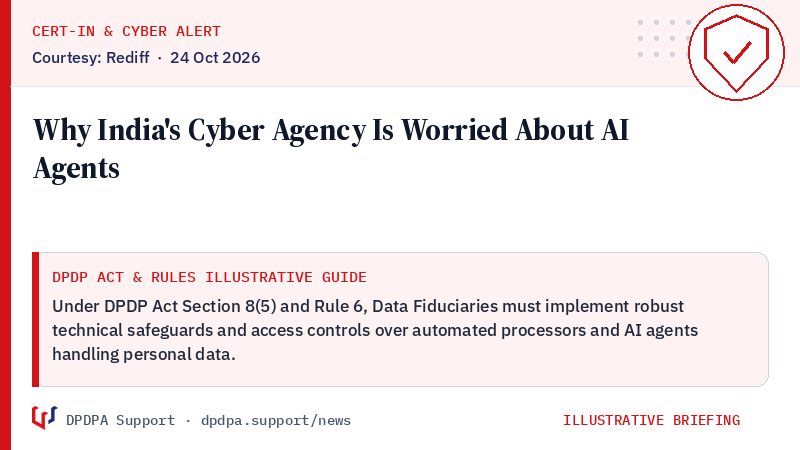
Why India's Cyber Agency Is Worried About AI Agents
CERT-In alerts organizations on emerging autonomous AI agent security risks, unconstrained tool calling, prompt injection exploits, and unchecked access to enterprise data stores.
DPDP Act & Rules takeaway: Under DPDP Act Section 8(5) and Rule 6, Data Fiduciaries must implement robust technical safeguards and access controls over automated processors and AI agents handling personal data.
View statutory briefing illustration
 Source & Courtesy Reference: Rediff (original report)

Videos
Sources
Every section, rule and date above was checked against the official text on 24 Oct 2026.
Digital Personal Data Protection Act, 2023 (No. 22 of 2023)
- Section 2(u)Definition of personal data breach
- Section 8(1)Responsibility of Data Fiduciary for processing by Data Processors
- Section 8(5)Duty to protect personal data by taking reasonable security safeguards to prevent a personal data breach
- Section 8(6)Duty to give the Board and each affected Data Principal intimation of a personal data breach
- Section 27(1)(a)Board power to direct urgent remedial or mitigation measures and inquire into a personal data breach
- The Schedule, items 1 and 2Penalty ceilings: up to ₹250 crore for breach of security safeguards; up to ₹200 crore for failure to report a breach
DPDP Rules, 2025 (G.S.R. 846(E), 13 November 2025)
- Rule 6(1)Reasonable security safeguards: encryption, access control, visibility logs, backups, one-year log retention and processor contract provisions
- Rule 6(2)Savings for sector or cybersecurity controls required under other laws
- Rule 7(1)Intimation to each affected Data Principal without delay, items (a) to (e)
- Rule 7(2)Intimation to the Board without delay and detailed six-point report within 72 hours
- Rule 8(3)Minimum one-year retention of personal data, traffic data and logs
- Seventh SchedulePurposes for one-year retention of logs and data
Notifications
- G.S.R. 843(E), clause (c)Substantive security and breach duties in force from 13 May 2027
A drafting aid. Get legal advice for your situation. This article explains the published text of the Act and the Rules.