On this page
- Who counts as a child and why the 18-year line matters
- How verifiable parental consent works under the Rules
- The absolute ban on tracking, behavioural monitoring and targeted ads
- Where the Fourth Schedule exemptions apply—and where they stop
- Our view: six architecture checks for consumer, gaming and EdTech apps
- Common questions
- In the news
- Sources
Recent Supreme Court observations on protecting children online, combined with policy debates around age-verification gates and platform accountability, have put under-18 digital safety at the top of boardroom agendas across India. For product, legal and trust-and-safety teams building social networks, gaming apps, learning platforms, streaming services and consumer websites, the Digital Personal Data Protection Act, 2023 and the DPDP Rules, 2025 set the binding statutory rulebook that takes effect on 13 May 2027.
Who counts as a child and why the 18-year line matters
Under India's data protection statute, a child is any individual who has not completed the age of eighteen years. Unlike foreign privacy regimes that set child-consent thresholds at thirteen or sixteen years of age, Indian law applies its child-data protections all the way up to a user's eighteenth birthday. For any child, the definition of Data Principal includes the parents or the lawful guardian acting on the child's behalf.
This single threshold means that a consumer app serving sixteen-year-old high-school students, a competitive test-prep portal, an online multiplayer game or a short-video community cannot rely on a teenager's own click-through agreement to process personal data, unless a narrow statutory exemption applies.
| Platform workflow | What the DPDP Act and Rules require | Product and engineering implementation |
|---|---|---|
| Account sign-up by a user under 18 | Obtain verifiable consent of the parent or lawful guardian before processing any personal data of the child | Pause account creation for under-18 users until parent identity and age are verified and affirmative consent is recorded |
| Verifying the parent's age and identity | Check that the person giving consent is an adult identifiable through reliable details already held or a government-issued or Digital Locker token | Integrate Digital Locker virtual tokens or verify against an existing verified adult account on the platform |
| Analytics, feeds and recommendation engines | Do not undertake tracking or behavioural monitoring of children | Disable behavioural event beacons, cross-app trackers and engagement-maximising profiling on under-18 accounts |
| Ad-supported content and promotions | Do not undertake targeted advertising directed at children | Switch under-18 sessions strictly to non-targeted contextual banners or subscription-only views |
| Safety features and content moderation | Do not undertake any processing of personal data that is likely to cause any detrimental effect on the well-being of a child | Audit recommendation algorithms, chat features and public profile defaults to prevent harm to minors |
| School, hospital or child-safety transport portals | Fourth Schedule exemptions excuse parental consent and tracking bans only for strictly limited welfare, education and safety duties | Keep instructional and bus-location data strictly isolated from commercial marketing or ad-tech SDKs |
How verifiable parental consent works under the Rules
The Rules require every Data Fiduciary to adopt appropriate technical and organisational measures to ensure that verifiable consent of the parent is obtained before processing any personal data of a child. More specifically, the organisation must exercise due diligence to check that the individual identifying herself as the parent is an adult who is identifiable if required in connection with compliance with any law in force in India.

In doing so, the Rules state that the Data Fiduciary must verify the parent's identity and age by reference to:
- Reliable details of identity and age of the individual already available with the Data Fiduciary; or
- Voluntarily provided details of identity and age, or a virtual token mapped to the same, which is issued by an authorised entity—including an entity entrusted by law or the Government—and includes details or a token verified and made available by a Digital Locker service provider.
The statutory illustrations walk through how this works in practice. When a child informs an online platform that she is under eighteen, the platform must enable her parent to verify her age and identity either through an existing adult account on the same platform or through a Digital Locker service provider before creating the child's account.
The absolute ban on tracking, behavioural monitoring and targeted ads
Even after a parent completes identity verification and gives valid consent, the platform does not receive a blank cheque to monetise the child's profile. The Act places two standalone prohibitions alongside parental consent:
- A Data Fiduciary must not undertake processing of personal data that is likely to cause any detrimental effect on the well-being of a child.
- A Data Fiduciary must not undertake tracking or behavioural monitoring of children, or targeted advertising directed at children.
For mobile apps and websites, this requires a clean architectural split between adult accounts and under-18 accounts. Third-party advertising software development kits, behavioural retargeting pixels, cross-site profiling cookies and targeted promotional notifications must be switched off whenever the logged-in profile belongs to a user under eighteen.
Where the Fourth Schedule exemptions apply—and where they stop
The Rules and the Fourth Schedule grant targeted exemptions from the parental-consent and tracking restrictions for specific classes of Data Fiduciaries—including clinical establishments, mental health establishments, healthcare professionals, allied healthcare professionals and educational institutions—and for specific child-safety purposes such as location tracking of a child during school transport. In every case, however, the exemption is restricted strictly to the processing needed for health treatment, educational activities or the safety of the child. Using student or patient records for commercial advertising or lead generation remains outside the exemption.
Our view: six architecture checks for consumer, gaming and EdTech apps
In our view, product managers, engineers and privacy counsel building platforms used by young people in India should complete six practical checks before 13 May 2027:
- Design a neutral age-declaration step at onboarding that identifies users under 18 without nudging them to falsify their birth year.
- Build a parent-verification workflow that links the child's pending sign-up either to an existing verified adult account or to a Digital Locker virtual token check.
- Create a dedicated "under-18 privacy mode" in your mobile and web codebase that disables third-party ad-tech SDKs, behavioural telemetry and targeted push notifications at runtime.
- Set child and teen profiles to private by default, restricting direct messaging, public location tags and contact-list syncing.
- If you operate a school or healthcare platform, segregate Fourth Schedule educational or clinical records from any commercial cross-sell or marketing database.
- Give parents a simple dashboard to review the personal data held about their child, withdraw consent or request erasure in a few clicks.
Common questions
What age threshold defines a child under the DPDP Act in India?
A child is any individual who has not completed the age of eighteen years. For a child, the Data Principal includes the parents or lawful guardian acting on the child’s behalf.
How must an online platform verify that a parent giving consent is an identifiable adult?
The Data Fiduciary must verify the parent’s identity and age either through reliable identity and age details already held by the platform, or through voluntarily provided details or a virtual token issued by an authorised entity or a Digital Locker service provider.
Can an app show targeted ads or run behavioural tracking on a user under 18 if the parent consents?
No. Even with parental consent, the Act prohibits tracking or behavioural monitoring of children and prohibits targeted advertising directed at children, unless a specific Fourth Schedule exemption applies.
What is the maximum penalty ceiling for breaching children’s data obligations under the Act?
The Schedule sets a penalty ceiling that may extend to ₹200 crore for breach in observance of the additional obligations in relation to children.
Next steps
- Check whether the DPDP Act applies to your business, free, in a few clicks
- How-to 05: Ask properly, in the toolkit
- How-to 03: Know your data, in the toolkit
- The free duties list, every duty in plain words
In the news
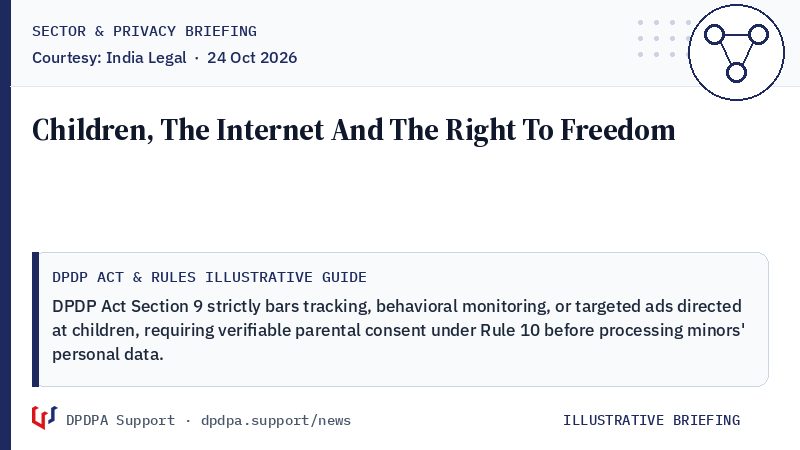
Children, The Internet And The Right To Freedom
Judicial analysis on balancing children's digital access rights with protective safeguards, age verification mandates, and parental consent frameworks.
DPDP Act & Rules takeaway: DPDP Act Section 9 strictly bars tracking, behavioral monitoring, or targeted ads directed at children, requiring verifiable parental consent under Rule 10 before processing minors' personal data.
View statutory briefing illustration
 Source & Courtesy Reference: India Legal (original report)
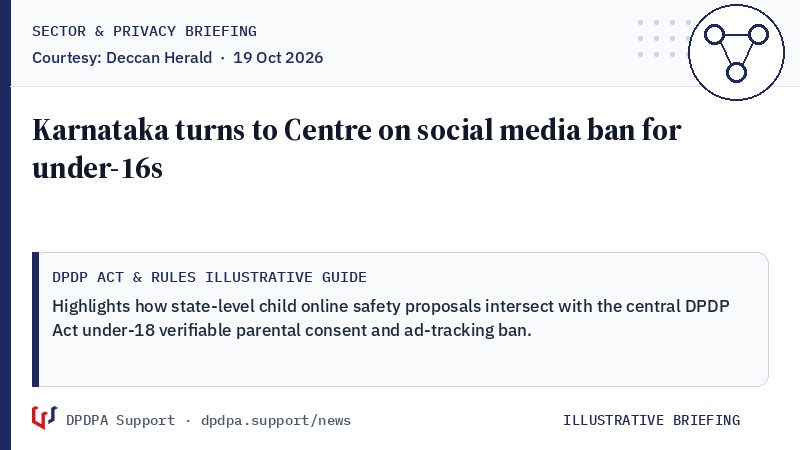
Karnataka turns to Centre on social media ban for under-16s
State policymakers consult the Union Government on regulating minors' access to social media platforms and enforcing age-gate safeguards.
DPDP Act & Rules takeaway: Highlights how state-level child online safety proposals intersect with the central DPDP Act under-18 verifiable parental consent and ad-tracking ban.
View statutory briefing illustration
 Source & Courtesy Reference: Deccan Herald (original report)

Videos
Sources
Every section, rule and date above was checked against the official text on 24 Oct 2026.
Digital Personal Data Protection Act, 2023 (No. 22 of 2023)
- Section 2(f)Child means an individual who has not completed the age of eighteen years
- Section 2(j)Data Principal for a child includes the parents or lawful guardian
- Section 9(1)Verifiable consent of the parent or lawful guardian before processing personal data of a child
- Section 9(2)Prohibition on processing likely to cause any detrimental effect on the well-being of a child
- Section 9(3)Prohibition on tracking, behavioural monitoring of children or targeted advertising directed at children
- Section 9(4)Exemptions for specified classes of Data Fiduciaries or purposes subject to conditions
- The Schedule, item 3Penalty ceiling up to ₹200 crore for breach of obligations in relation to children
DPDP Rules, 2025 (G.S.R. 846(E), 13 November 2025)
- Rule 10Verifiable parental consent: due diligence, adult identity and age check, Digital Locker virtual token and four illustration cases
- Rule 11Verifiable consent of lawful guardian of a person with disability
- Rule 12Exemptions from certain obligations applicable to processing of personal data of a child
- Fourth Schedule, Part A and Part BExempted classes (clinical establishments, educational institutions, childcare) and purposes (safety, location tracking) with conditions
Notifications
- G.S.R. 843(E), clause (c)Children’s data obligations in force eighteen months from 13 November 2025 (13 May 2027)
A drafting aid. Get legal advice for your situation. This article explains the published text of the Act and the Rules.