On this page
- How sectoral regulatory notices interact with the DPDP Act across industries
- October 2026 sectoral public notices and circulars mapped to DPDP Rules controls
- Why a mandatory regulatory record is not a blank cheque for marketing
- Our view: how to wire sectoral regulatory notices into your DPDP workflow
- Common questions
- In the news
- Sources
Across India's regulated industries, statutory authorities issue a steady stream of public notices, circulars, advisories and master directions that tell businesses exactly what personal data, transaction records, call recordings, medical particulars or identity proofs they must collect and keep. In October 2026 alone, the National Dental Commission mandated nine particulars on every dental prescription, the Securities and Exchange Board of India reviewed call-record maintenance rules for institutional research analysts, the National Medical Commission clarified remote digital-signature authentication for medical records, the Reserve Bank of India updated foreign-exchange and loan-reset disclosures, and the University Grants Commission issued cybersecurity directives for higher educational institutions. As the 13 May 2027 enforcement date of the Digital Personal Data Protection Act, 2023 and the DPDP Rules, 2025 approaches, compliance teams across every vertical must understand how sectoral regulatory notices and horizontal data protection duties operate side by side.
How sectoral regulatory notices interact with the DPDP Act across industries
The DPDP Act is drafted as a horizontal statute: its provisions operate in addition to, and not in derogation of, any other law for the time being in force in India. Only in the event of a direct conflict between a provision of the DPDP Act and another law does the DPDP Act prevail to the extent of that conflict. In practice, this means that when a sector regulator—such as the Reserve Bank of India, SEBI, IRDAI, the National Medical Commission, the National Dental Commission, TRAI, the University Grants Commission or the Central Consumer Protection Authority—requires a business to collect specific particulars or retain records for a fixed period, that sectoral mandate establishes the lawful scope and retention floor for the regulatory record, while the DPDP Act governs notice transparency, security safeguards, vendor contracts, one-year processing logs and breach reporting.
October 2026 sectoral public notices and circulars mapped to DPDP Rules controls
Looking across the major industry verticals where Indian regulators issued circulars and public notices in October 2026 illustrates how a sectoral notice and the DPDP Rules fit together in daily operations:

| Industry vertical & regulator | October 2026 regulatory notice or circular | How the DPDP Act and Rules apply from 13 May 2027 |
|---|---|---|
| Healthcare, Dental & Clinics (NDC & NMC) | NDC Public Notice M-2749 (23 Oct 2026) on 9 mandatory prescription particulars and ban on pharma pads; NMC Notice (Oct 2026) on digital signature authentication of medical records | Clinical and prescription particulars are kept under statutory medical duties, but clinics must give standalone privacy notices, ban unauthorised pharma data sharing, sign Data Processor contracts with EMR vendors and keep 1-year access logs |
| Capital Markets, Brokers & Research (SEBI) | SEBI Circular (23 Oct 2026) reviewing call-record maintenance for institutional clients by Research Analysts; Project Jagrook (1 Oct 2026) investor awareness disclosures on trading apps | Where SEBI mandates call logs or KYC records, erasure on client request is paused for the statutory retention window; voice recordings and client logs must be encrypted, access-controlled and retained with 1-year security audit trails |
| Banking, NBFCs & Forex (RBI & NABARD) | RBI October 2026 circulars on floating-rate loan reset options, FEMA export-import declarations and Lead Bank district allocations | Loan agreements and regulatory disclosures do not replace a standalone DPDP consent notice for optional cross-selling; core banking hosts, recovery agencies and fintech partners require binding Data Processor agreements |
| Higher Education, Schools & EdTech (UGC & NTA) | UGC Advisories (16–23 Oct 2026) on Higher Educational Institution cybersecurity awareness, fee-refund compliance and UGC-NET candidate registration portals | Universities, schools and exam portals must secure student and candidate databases, obtain verifiable parental consent for learners under 18 outside Fourth Schedule educational duties, and prohibit behavioural ad tracking of minors |
| Telecom, Cloud & Messaging (DoT, TRAI & CERT-In) | October 2026 CERT-In high-severity advisories, DoT app-level SIM-binding security consultations and telecom spam-control directions | Technical patching and telecom verification tokens must be paired with least-privilege access, encryption, one-year traffic log retention and 72-hour personal data breach reporting to the Data Protection Board |
| E-Commerce, Retail & Consumer Platforms (CCPA & FSSAI) | Consumer protection advisories against deceptive dark-pattern consent flows and mandatory seller and food-operator disclosures on marketplaces | Pre-ticked boxes, bundled checkout terms and confusing opt-outs violate both consumer dark-pattern guidelines and the DPDP requirement for free, specific, informed and unconditional consent |
Why a mandatory regulatory record is not a blank cheque for marketing
The most common compliance mistake across regulated sectors—whether in a hospital, a stockbroking desk, a cooperative bank, an EdTech institute or an e-commerce marketplace—is assuming that because a regulator mandates collecting a customer's name, mobile number, Aadhaar/PAN or prescription history, the business may freely reuse that same database for promotional WhatsApp broadcasts, cross-selling or third-party sponsor campaigns. Under the DPDP Act, personal data processed for a statutory or regulatory requirement cannot be repurposed for commercial marketing without a standalone, itemised privacy notice and separate, unbundled consent that the individual can withdraw at any time.
Conversely, when a customer or patient withdraws marketing consent or submits an erasure request, the Data Fiduciary must erase the optional marketing profile and cause its Data Processors to erase it, while retaining the specific transaction, tax, call-log or medical records whose retention is necessary for compliance with an Indian law or sectoral circular.
Our view: how to wire sectoral regulatory notices into your DPDP workflow
In our view, legal, compliance and operations teams across banking, healthcare, education, retail, SaaS and corporate services should treat every new sectoral public notice or circular as a direct input to their DPDP governance register through six actions:
- Maintain a live sectoral notice register mapping each regulator's circular—such as NDC, NMC, RBI, SEBI, IRDAI, UGC, TRAI or CCPA directives—to the exact personal data fields it requires you to collect or retain.
- Separate mandatory regulatory fields from optional commercial or marketing fields in your intake forms, electronic prescriptions, onboarding screens and mobile apps.
- Configure your erasure and retention engine so a customer's deletion request immediately purges marketing and profiling data while placing a documented statutory hold on records required by sectoral notices.
- Update written Data Processor contracts whenever a sectoral circular introduces new digital signature, call-recording, cloud backup or cybersecurity standards for your vendors.
- Enforce encryption, role-based access controls and a minimum one-year retention pipeline for all processing and traffic logs across regulated databases.
- Train your grievance officer and customer desk to cite the applicable sectoral retention rule clearly when responding to Data Principal access or erasure requests within the 90-day statutory ceiling.
Common questions
Does the DPDP Act override sectoral circulars from RBI, SEBI, IRDAI, NMC or the National Dental Commission?
No. The DPDP Act operates in addition to, and not in derogation of, any other law in force in India. Only if there is a direct conflict between a provision of the DPDP Act and another law does the DPDP Act prevail to the extent of that conflict.
What happens when a client or patient asks to delete their data, but a SEBI, RBI or medical circular requires keeping the record?
The Data Fiduciary must erase optional marketing and non-statutory personal data upon consent withdrawal or erasure request, unless retention is necessary for compliance with any law in force in India—such as SEBI call-log mandates, RBI KYC rules, GST invoice retention or clinical record regulations.
Can a business use personal data collected under a mandatory regulatory notice for promotional WhatsApp or email marketing?
No. Collecting personal data to satisfy a statutory or regulatory mandate covers only that regulatory purpose. Any promotional outreach, cross-selling or third-party sponsorship requires a standalone privacy notice and free, specific, informed and unbundled consent.
What baseline security and logging rules apply to databases holding SEBI, RBI, medical or university records from 13 May 2027?
Every Data Fiduciary must protect regulated personal data with encryption, access controls and continuity backups, bind software and cloud vendors under written Data Processor contracts, retain traffic and processing logs for at least one year, and report any personal data breach to the Board within 72 hours.
Next steps
- Check whether the DPDP Act applies to your business, free, in a few clicks
- How-to 06: Keep only as long as needed, in the toolkit
- How-to 03: Know your data, in the toolkit
- How-to 04: Set the rules, in the toolkit
- The free duties list, every duty in plain words
In the news
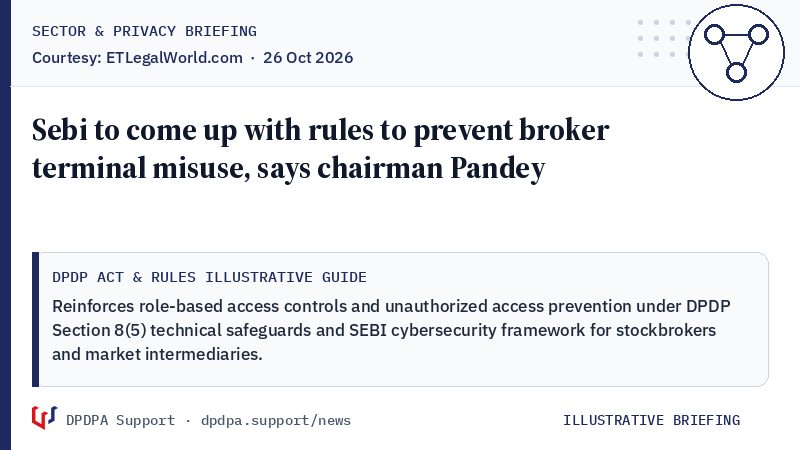
Sebi to come up with rules to prevent broker terminal misuse, says chairman Pandey
SEBI Chairperson announced forthcoming regulatory rules to prevent misuse of stockbroker trading terminals and unauthorized trading credential access.
DPDP Act & Rules takeaway: Reinforces role-based access controls and unauthorized access prevention under DPDP Section 8(5) technical safeguards and SEBI cybersecurity framework for stockbrokers and market intermediaries.
View statutory briefing illustration
 Source & Courtesy Reference: ETLegalWorld.com (original report)
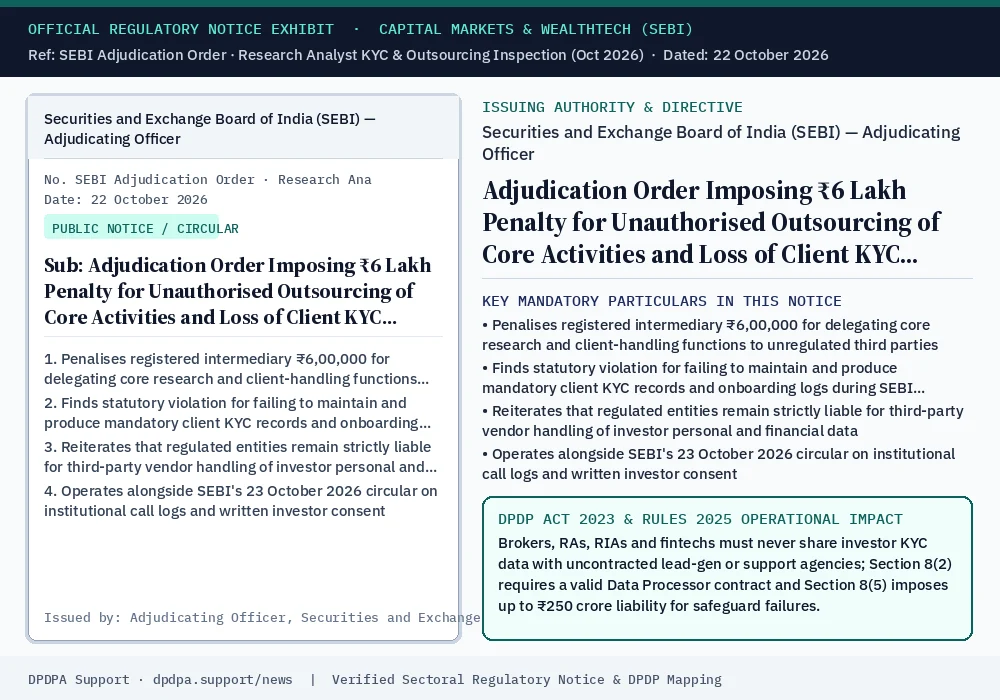
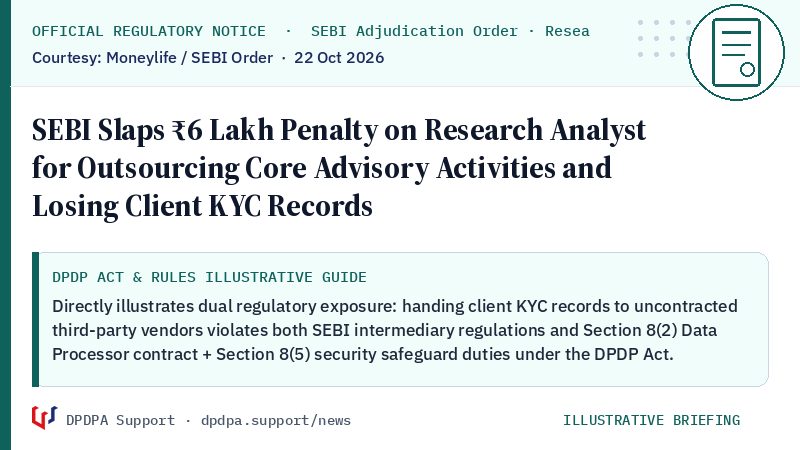
SEBI Slaps ₹6 Lakh Penalty on Research Analyst for Outsourcing Core Advisory Activities and Losing Client KYC Records
The Securities and Exchange Board of India (SEBI) imposed a ₹6 lakh monetary penalty on a registered Research Analyst after an inspection revealed unauthorised outsourcing of core activities to third parties and failure to preserve mandatory client KYC and fee records.
DPDP Act & Rules takeaway: Directly illustrates dual regulatory exposure: handing client KYC records to uncontracted third-party vendors violates both SEBI intermediary regulations and Section 8(2) Data Processor contract + Section 8(5) security safeguard duties under the DPDP Act.
Official Regulatory Notice Exhibit (SEBI Adjudication Order · Research Analyst KYC & Outsourcing Inspection (Oct 2026))
View statutory briefing illustration
 Source & Courtesy Reference: Moneylife / SEBI Order (original report)
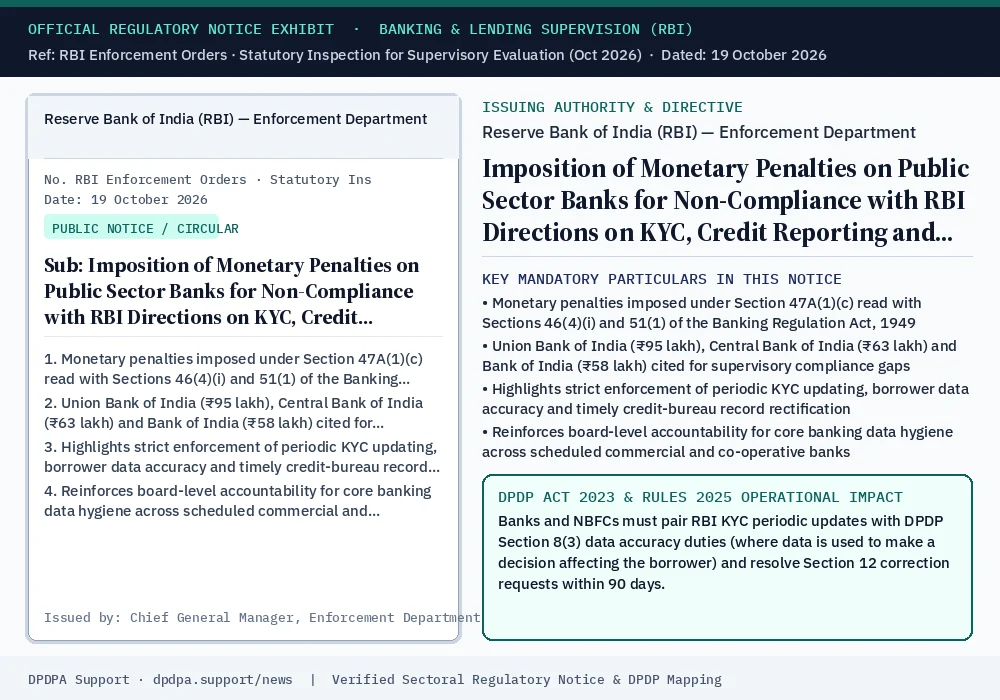
RBI Imposes Monetary Penalties on Union Bank of India (₹95 Lakh), Bank of India (₹58 Lakh) and Central Bank of India (₹63 Lakh)
The Reserve Bank of India (RBI) imposed monetary penalties totalling ₹2.16 crore across Union Bank of India (₹95 lakh), Central Bank of India (₹63 lakh) and Bank of India (₹58 lakh) following Statutory Inspections for Supervisory Evaluation (ISE) that uncovered lapses in KYC directions, credit-information reporting and borrower account governance.
DPDP Act & Rules takeaway: Under Section 12(1) of the DPDP Act, borrowers have a statutory right to correction and updating of inaccurate personal and credit records—making KYC accuracy and bureau reporting hygiene a dual RBI and DPDP imperative.
Official Regulatory Notice Exhibit (RBI Enforcement Orders · Statutory Inspection for Supervisory Evaluation (Oct 2026))
View statutory briefing illustration
 Source & Courtesy Reference: Fintech BizNews / RBI Enforcement (original report)
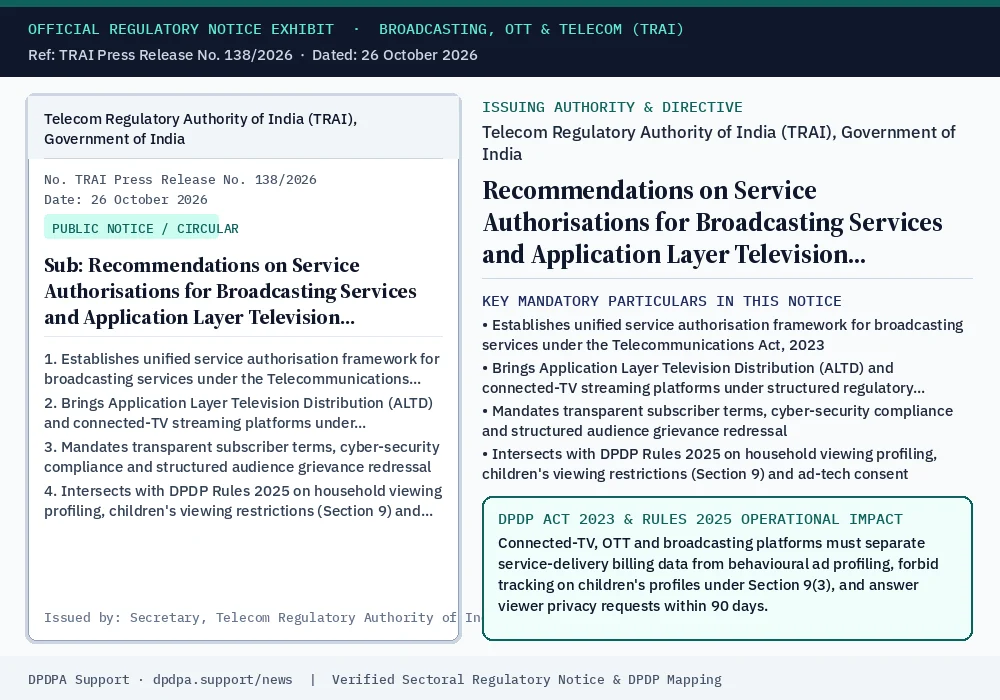
TRAI Press Release No. 138/2026: Recommendations on Authorisations for Broadcasting Services and Connected TV (ALTD) Rules
TRAI issued Press Release No. 138/2026 on 26 October 2026 announcing comprehensive recommendations on service authorisations for broadcasting services under the Telecommunications Act, 2023, including Application Layer Television Distribution (ALTD), FAST channels, DTH/HITS infrastructure sharing and audience grievance governance.
DPDP Act & Rules takeaway: Connected-TV apps, FAST streaming platforms and digital cable/DTH operators collecting household viewing telemetry and subscriber billing records must pair TRAI authorisation compliance with DPDP Rule 3 consent notices and Rule 8 1-year logs.
Official Regulatory Notice Exhibit (TRAI Press Release No. 138/2026)
View statutory briefing illustration
 Source & Courtesy Reference: Telecom Regulatory Authority of India (TRAI) (original report)
EPFO Circular Extends Electronic Challan-cum-Return (ECR) Filing Due Date Following ₹25,000 Wage Ceiling Revision
The Employees' Provident Fund Organisation (EPFO) issued an October 2026 circular extending the Electronic Challan-cum-Return (ECR) filing and statutory contribution window to 31 October 2026 to help employers onboard newly eligible employees following the statutory wage-ceiling revision to ₹25,000 per month.
DPDP Act & Rules takeaway: Onboarding newly eligible employees into EPFO UAN and Aadhaar-linked payroll workflows falls under Section 7(b) statutory compliance and Section 7(i) employment purposes—requiring an itemised employee privacy notice and a signed Data Processor contract with the payroll vendor.
Official Regulatory Notice Exhibit (EPFO Compliance Circular · ECR Filing & Wage Ceiling Onboarding (Oct 2026))
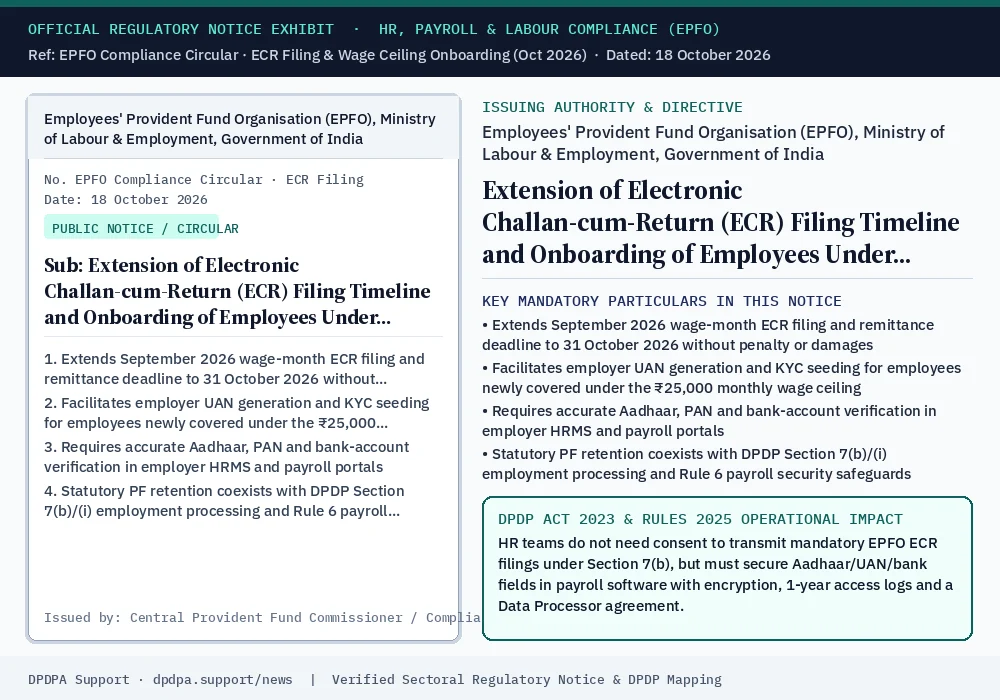
View statutory briefing illustration
 Source & Courtesy Reference: Employees' Provident Fund Organisation (EPFO) (original report)
SEBI Circular: Review of regulatory requirement for maintenance of call records of institutional clients by Research Analysts or Research Entities
SEBI issued its 23 October 2026 circular reviewing the regulatory requirement for maintenance of call records and communication logs of institutional clients by registered Research Analysts and Research Entities.
DPDP Act & Rules takeaway: Illustrates DPDP Section 8(7)(b), Section 12(3) and Section 38: mandatory SEBI communication and call-record retention rules pause erasure requests during statutory retention windows while requiring Rule 6 encryption and 1-year security logs.
Official Regulatory Notice Exhibit (SEBI/HO/MIRSD/Oct-2026/105400)
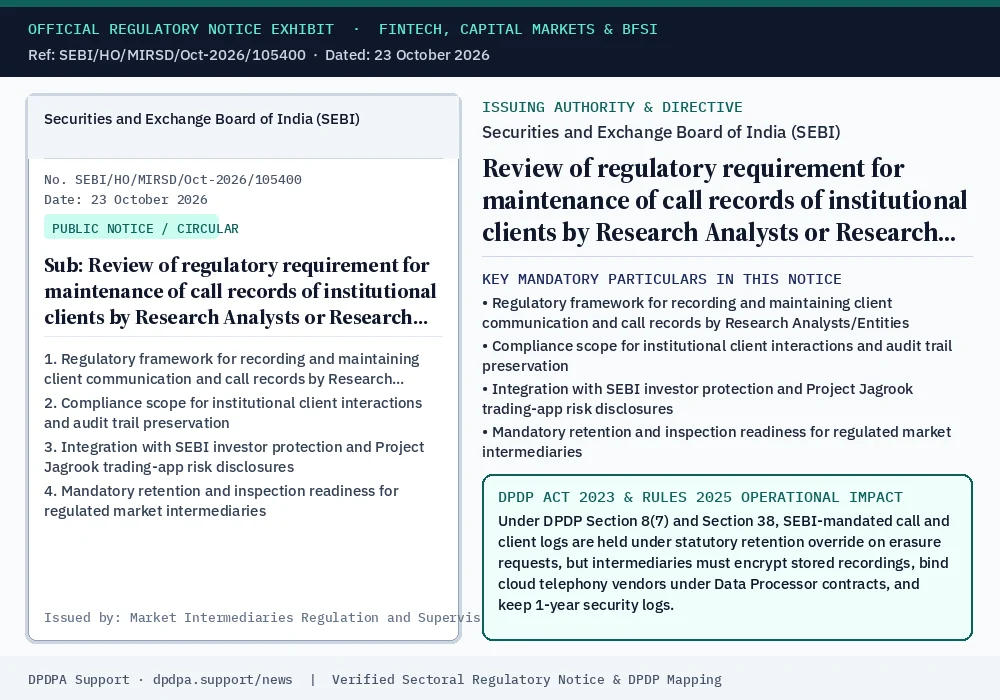
View statutory briefing illustration
 Source & Courtesy Reference: Securities and Exchange Board of India (SEBI) (original report)
Public Notice F.No.NDC/EDRB/Public-Notice/2026/M-2749: Advisory for Mandatory Particulars on Prescriptions Issued by Practising Dentists
The Ethics and Dental Registration Board (EDRB) of the National Dental Commission directed all practising dentists to include 9 mandatory particulars on every paper and electronic prescription and banned pharmaceutical-sponsored prescription pads.
DPDP Act & Rules takeaway: Maps to DPDP Act Section 5, Section 6, Section 8(2) and Rule 6: clinics must give standalone privacy notices, prohibit unauthorised pharma data sharing, sign Data Processor contracts with e-prescription vendors and keep 1-year security logs.
Official Regulatory Notice Exhibit (F.No.NDC/EDRB/Public-Notice/2026/M-2749)
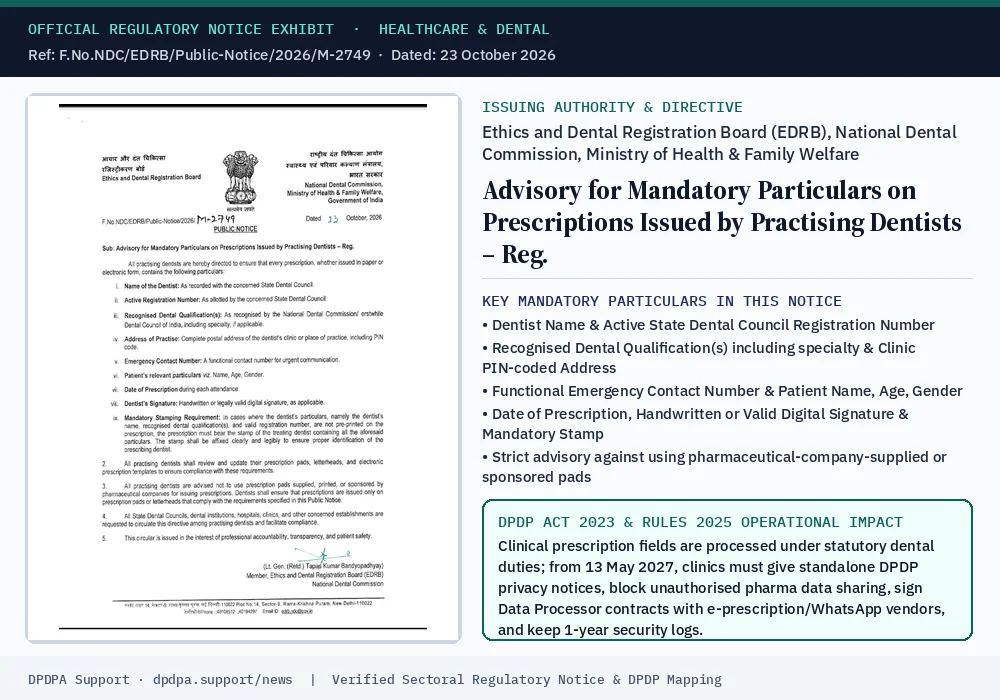
View statutory briefing illustration
 Source & Courtesy Reference: National Dental Commission (EDRB) / DCI (original report) Medical Dialogues
NMC Public Notices (Oct 2026): Remote Authentication of Medical Records via Digital Signatures & Ethical Hospital Communication Guidelines
The National Medical Commission issued October 2026 directives clarifying remote authentication of medical records using digital/electronic signatures and guidelines on ethical public communication by hospitals and registered medical practitioners.
DPDP Act & Rules takeaway: Hospital and clinic electronic health record systems using digital signatures must enforce DPDP Rule 6 access controls, 1-year audit logs, and unbundled patient consent before any promotional communication.
Official Regulatory Notice Exhibit (NMC/Whats-New/Oct-2026/1874)
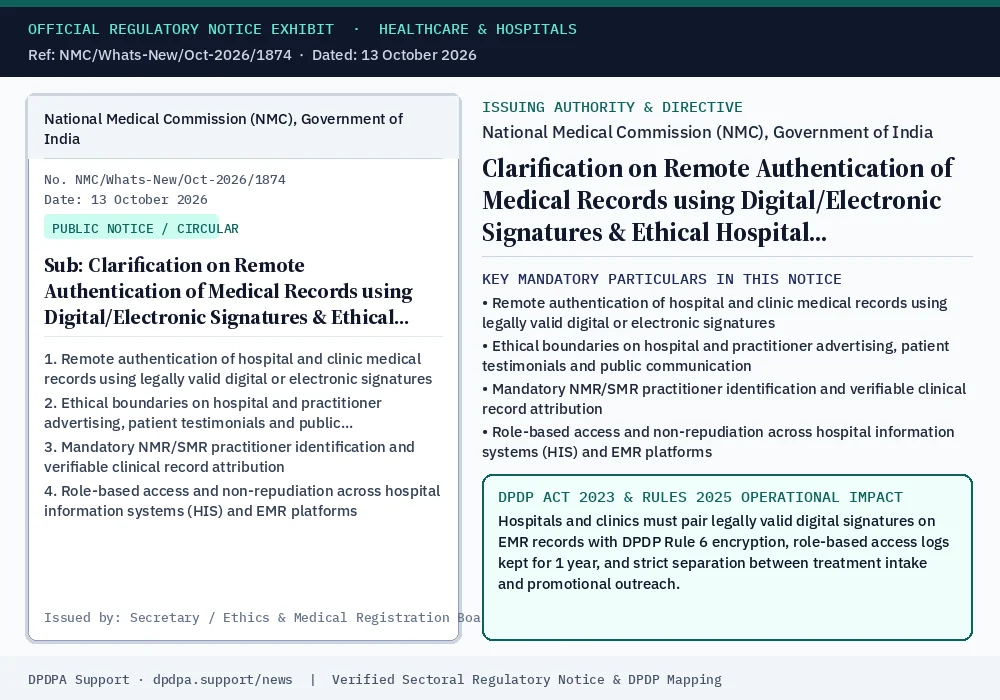
View statutory briefing illustration
 Source & Courtesy Reference: National Medical Commission (NMC) (original report) NMC Official Portal
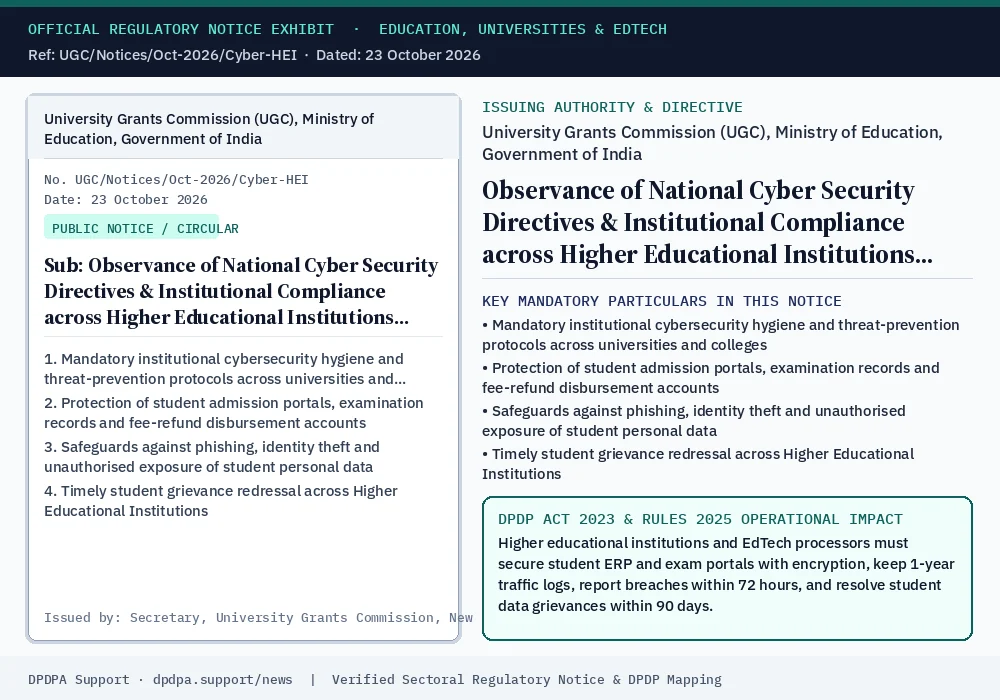
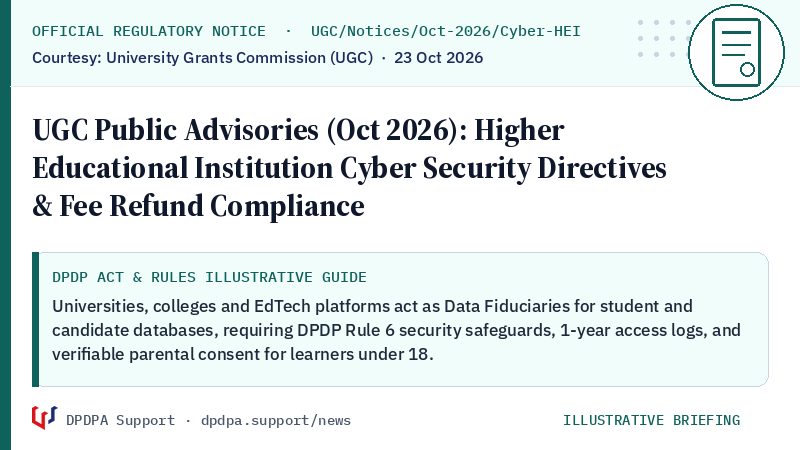
UGC Public Advisories (Oct 2026): Higher Educational Institution Cyber Security Directives & Fee Refund Compliance
The University Grants Commission issued October 2026 public notices instructing Higher Educational Institutions (HEIs) on National Cyber Security Awareness protocols, cybercrime prevention and strict compliance with student fee-refund norms.
DPDP Act & Rules takeaway: Universities, colleges and EdTech platforms act as Data Fiduciaries for student and candidate databases, requiring DPDP Rule 6 security safeguards, 1-year access logs, and verifiable parental consent for learners under 18.
Official Regulatory Notice Exhibit (UGC/Notices/Oct-2026/Cyber-HEI)
View statutory briefing illustration
 Source & Courtesy Reference: University Grants Commission (UGC) (original report)






Videos
Sources
Every section, rule and date above was checked against the official text on 27 Oct 2026.
Digital Personal Data Protection Act, 2023 (No. 22 of 2023)
- Section 5(1)Standalone privacy notice before or with every request for consent
- Section 6(1)Free, specific, informed, unconditional and unambiguous consent
- Section 8(2)Engaging a Data Processor only under a valid contract
- Section 8(5)Duty to protect personal data by taking reasonable security safeguards
- Section 8(6)Duty to notify the Board and each affected individual of a personal data breach
- Section 8(7)Duty to erase personal data on withdrawal of consent or when the specified purpose is no longer served, unless retention is necessary for compliance with any law
- Section 12(3)Right to erasure of personal data unless retention is necessary for the specified purpose or compliance with any law
- Section 38(1)Provisions of the Act are in addition to and not in derogation of any other law
- Section 38(2)In the event of any conflict, provisions of the Act prevail to the extent of such conflict
DPDP Rules, 2025 (G.S.R. 846(E), 13 November 2025)
- Rule 3Standalone, plain-language consent notice requirements
- Rule 6(1)Encryption, access control, visibility logs, backups, one-year logs and processor contracts
- Rule 7(2)Detailed breach report to the Data Protection Board within 72 hours
- Rule 8(3)Minimum one-year retention of personal data, traffic data and logs
- Rule 14(3)Maximum 90-day period to respond to grievances
Notifications
- G.S.R. 843(E), clause (c)Substantive Data Fiduciary duties in force from 13 May 2027
A drafting aid. Get legal advice for your situation. This article explains the published text of the Act and the Rules.