
On this page
- Why the Central Government issued the Removal of Difficulties Order, 2026
- How the October 2026 Order clarifies guardian consent and Significant Data Fiduciary data audits
- What lawful guardian verification requires in practice
- Our view: five steps to update your compliance programme for the 2026 Order
- Common questions
- In the news
- Sources
In October 2026, the Ministry of Electronics and Information Technology notified the Digital Personal Data Protection (Removal of Difficulties) Order, 2026 in the Official Gazette, exercising the Central Government's statutory power to remove difficulties in giving effect to the Digital Personal Data Protection Act, 2023 within three years from commencement. While concise in length, the October 2026 Order resolves two drafting ambiguities that legal, product and compliance teams had flagged since the statute was enacted: first, aligning the phrasing around verifiable consent from parents and lawful guardians when processing the personal data of children and persons with disabilities; and second, replacing the generic word "audit" with the precise statutory term "data audit" in the periodic compliance obligations of Significant Data Fiduciaries.
Why the Central Government issued the Removal of Difficulties Order, 2026
The DPDP Act empowers the Central Government, if any difficulty arises in giving effect to the provisions of the statute, to make provisions not inconsistent with the Act by a published order as appear necessary or expedient for removing the difficulty, provided no such order is made after the expiry of three years from the commencement of the Act and every order is laid before each House of Parliament. As enterprises, ministries and sector regulators prepared their systems ahead of the 13 November 2026 Consent Manager registration milestone and the 13 May 2027 enforcement date for substantive Data Fiduciary duties, two textual seams between the parent Act and the DPDP Rules, 2025 required formal alignment.
First, in the clause governing verifiable consent before processing any personal data of a child or a person with disability who has a lawful guardian, the parent Act's cross-references between parental consent for children under 18 and guardian consent for persons with disabilities needed grammatical precision so that the verifiable consent mechanisms prescribed in the Rules apply cleanly to both categories. Second, in the clause requiring a Significant Data Fiduciary to appoint an independent data auditor, one sub-clause referred to conducting periodic "audit" rather than periodic "data audit", creating unnecessary debate over whether general financial or statutory corporate audits overlapped with the independent privacy audit regime.
How the October 2026 Order clarifies guardian consent and Significant Data Fiduciary data audits
By issuing the Digital Personal Data Protection (Removal of Difficulties) Order, 2026, the government locked both provisions into exact alignment with the DPDP Rules, 2025:

| Statutory area clarified by the 2026 Order | What the textual clarification resolves | Operational requirement for Data Fiduciaries from 13 May 2027 |
|---|---|---|
| Verifiable consent for children under 18 years of age | Harmonises the wording on obtaining verifiable consent of the parent or lawful guardian before processing any personal data of a child | Verify that the parent is an identifiable adult using reliable identity or age details held by the fiduciary or a Digital Locker token before activating a child account |
| Verifiable consent for persons with disabilities having a lawful guardian | Clarifies that where an individual with a disability cannot make legally binding decisions even with support, verifiable consent must come from a court-appointed or designated-authority lawful guardian | Verify that the lawful guardian was duly appointed by a court of law, a designated authority or a local level committee under the disability welfare laws before collecting consent |
| Prohibition on detrimental processing, tracking and targeted ads for children | Keeps the strict protection floor intact alongside the clarified guardian consent text unless a specific Fourth Schedule exemption applies | Disable behavioural monitoring, profiling and targeted advertising for all users under 18 across apps, websites, games and learning portals |
| Substitution of "audit" with "data audit" for Significant Data Fiduciaries | Clarifies that a notified Significant Data Fiduciary's independent data auditor evaluates compliance with the DPDP Act and Rules—not general financial accounting | Where notified as a Significant Data Fiduciary, conduct an annual Data Protection Impact Assessment and an annual independent data audit, and report key observations to the Board |
| Alignment with one-year security logs and processor governance | Ensures independent data audits inspect technical safeguards, consent records, vendor contracts and log retention pipelines | Maintain encryption, access controls, binding Data Processor contracts and at least one year of processing and traffic logs for audit verification |
| Parliamentary oversight and three-year window | Issued within the three-year window for removal-of-difficulties orders and required to be laid before each House of Parliament | Track all Gazette notifications and Central Government orders alongside the parent Act and the 2025 Rules in your compliance register |
What lawful guardian verification requires in practice
For hospitals, diagnostic labs, banks, insurers, schools and digital platforms that serve individuals with disabilities who have a lawful guardian, the DPDP Rules set out a specific verification standard. Unlike parental verification for a child—which relies on checking that the parent is an adult through existing reliable records or a Digital Locker virtual token—verifying a lawful guardian for a person with disability requires checking that the guardian was appointed by a court of law, by a designated authority under the Rights of Persons with Disabilities Act, 2016, or by a local level committee under the National Trust for Welfare of Persons with Autism, Cerebral Palsy, Mental Retardation and Multiple Disabilities Act, 1999.
Our view: five steps to update your compliance programme for the 2026 Order
In our view, engineering, legal and compliance teams should reflect the Digital Personal Data Protection (Removal of Difficulties) Order, 2026 in their readiness work before 13 May 2027 through five steps:
- Update your internal statutory reference pack and board briefing notes to record the October 2026 Removal of Difficulties Order alongside the DPDP Act, 2023, commencement notification G.S.R. 843(E) and the DPDP Rules, 2025.
- Separate your onboarding workflows for minors under 18 (adult parent verification via existing records or Digital Locker tokens) from workflows for persons with disabilities acting through a lawful guardian (verification of court, designated-authority or local-level-committee guardianship orders).
- If your organisation operates at a scale or sensitivity likely to be notified as a Significant Data Fiduciary, scope your internal readiness checklist around an annual independent data audit and an annual Data Protection Impact Assessment.
- Ensure your consent management, encryption, Data Processor contract register and minimum one-year log retention pipelines produce verifiable evidence ready for an independent data auditor.
- Keep your 90-day Data Principal rights and grievance desk accessible to parents and lawful guardians exercising access, correction, erasure or withdrawal rights on behalf of a child or person with disability.
Common questions
What did the Digital Personal Data Protection (Removal of Difficulties) Order, 2026 change?
Notified by the Ministry of Electronics and Information Technology in October 2026, the Order resolved two textual ambiguities in the parent Act: it aligned the phrasing on obtaining verifiable consent from a parent or lawful guardian for children and persons with disabilities, and replaced the word "audit" with "data audit" in the periodic compliance obligations of Significant Data Fiduciaries.
Under what legal power can the Central Government issue a Removal of Difficulties Order under the DPDP Act?
If any difficulty arises in giving effect to the provisions of the Act, the Central Government may, before the expiry of three years from commencement, make provisions not inconsistent with the Act by a published order as appear necessary or expedient for removing the difficulty, and every such order must be laid before each House of Parliament.
How does verifying a parent for a child differ from verifying a lawful guardian for a person with disability under the DPDP Rules?
For a child under 18, the Data Fiduciary verifies that the parent is an identifiable adult using reliable identity or age details already held or via a Digital Locker token. For a person with disability who cannot make legally binding decisions even with support, the fiduciary must verify that the lawful guardian was appointed by a court, a designated authority or a local level committee under the applicable disability laws.
Who is required to appoint an independent data auditor and conduct a periodic data audit?
Only a Data Fiduciary that has been notified by the Central Government as a Significant Data Fiduciary is required to appoint an independent data auditor and undertake a Data Protection Impact Assessment and a data audit once in every period of twelve months from 13 May 2027.
Next steps
- Check whether the DPDP Act applies to your business, free, in a few clicks
- How-to 08: Check risky processing, in the toolkit
- How-to 05: Ask properly, in the toolkit
- How-to 02: Plan the work, in the toolkit
- The free duties list, every duty in plain words
In the news
MeitY Notifies Digital Personal Data Protection (Removal of Difficulties) Order, 2026 on Guardian Consent and Data Audits
The Ministry of Electronics and Information Technology (MeitY) issued the Digital Personal Data Protection (Removal of Difficulties) Order, 2026 in the Official Gazette, aligning Section 9(1) verifiable guardian consent for persons with disabilities with clinical and guardianship laws and replacing the hyphenated phrase 'data-audit' with 'data audit' in Section 10(2)(c)(ii).
DPDP Act & Rules takeaway: Every platform serving minors or persons with disabilities with a lawful guardian, and every enterprise preparing for Significant Data Fiduciary obligations, must align its consent verification and independent data audit schedules with the 2026 Gazette Order before 13 May 2027.
Official Regulatory Notice Exhibit (DPDP (Removal of Difficulties) Order, 2026 · Section 43(1))
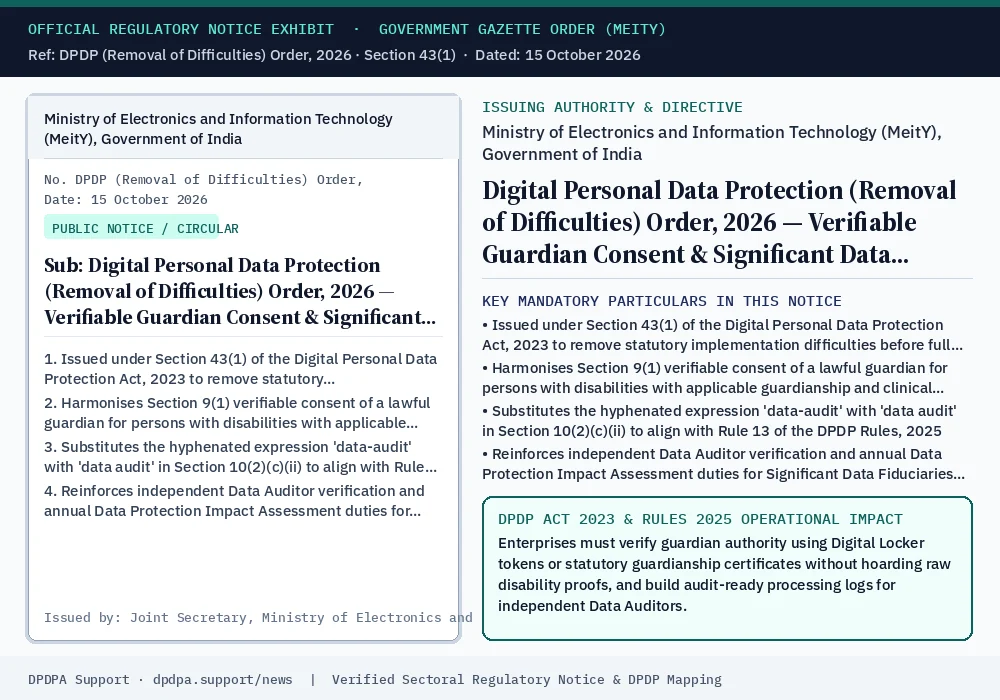
View statutory briefing illustration
Supreme Court Issues Notice to Centre on 21 News Publishers' Challenge to DPDP Act and Rules; Declines Ex Parte Stay
A Supreme Court bench led by Chief Justice of India Surya Kant issued notice to the Union of India on writ petitions filed by the Digital News Publishers Association (DNPA) and 21 digital arms of legacy media houses challenging the absence of a standalone journalistic exemption in the DPDP Act, 2023 and DPDP Rules, 2025, listing the matter for 17 November 2026 without granting an interim stay.
DPDP Act & Rules takeaway: Because no interim stay was granted, the statutory compliance calendar remains unchanged—Consent Manager registration opens on 13 November 2026 and full Data Fiduciary obligations take effect on 13 May 2027.
Official Regulatory Notice Exhibit (W.P.(C) by Digital News Publishers Association (DNPA) & 21 Publishers v. Union of India)
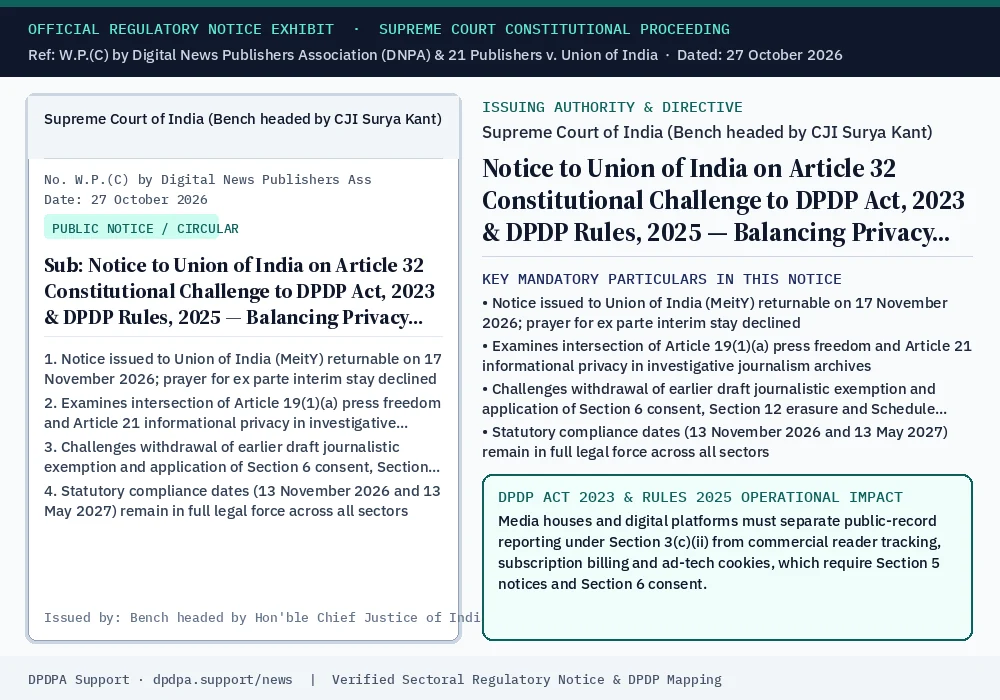
View statutory briefing illustration
UGC Public Advisories (Oct 2026): Higher Educational Institution Cyber Security Directives & Fee Refund Compliance
The University Grants Commission issued October 2026 public notices instructing Higher Educational Institutions (HEIs) on National Cyber Security Awareness protocols, cybercrime prevention and strict compliance with student fee-refund norms.
DPDP Act & Rules takeaway: Universities, colleges and EdTech platforms act as Data Fiduciaries for student and candidate databases, requiring DPDP Rule 6 security safeguards, 1-year access logs, and verifiable parental consent for learners under 18.
Official Regulatory Notice Exhibit (UGC/Notices/Oct-2026/Cyber-HEI)
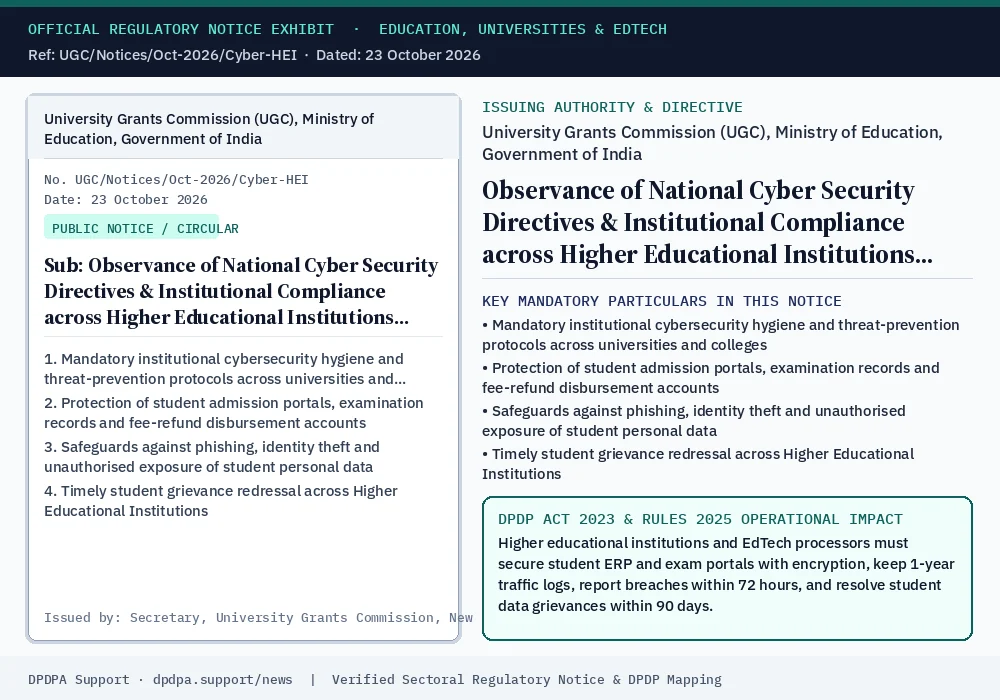
View statutory briefing illustration
 Source & Courtesy Reference: University Grants Commission (UGC) (original report)
MeitY notifies Digital Personal Data Protection Rules, 2025
DPDP Act & Rules takeaway: Official PIB release on the notified DPDP Rules, 2025 (G.S.R. 846(E)) setting out Rule 10/11 guardian verification and Rule 13 Significant Data Fiduciary data audit duties.
View statutory briefing illustration
 Source & Courtesy Reference: Press Information Bureau (original report)



Videos
Sources
Every section, rule and date above was checked against the official text on 27 Oct 2026.
Digital Personal Data Protection Act, 2023 (No. 22 of 2023)
- Section 9(1)Verifiable consent of the parent or lawful guardian before processing personal data of a child or a person with disability
- Section 10(2)(c)Significant Data Fiduciary duties: independent data auditor, periodic data audit and Data Protection Impact Assessment
- Section 43(1)Power of Central Government to remove difficulties by published order within three years of commencement
- Section 43(2)Every removal-of-difficulties order to be laid before each House of Parliament
DPDP Rules, 2025 (G.S.R. 846(E), 13 November 2025)
- Rule 10Verifiable consent of parent for processing personal data of a child
- Rule 11Verifiable consent of lawful guardian for processing personal data of a person with disability
- Rule 13Additional obligations of Significant Data Fiduciary: annual DPIA and annual data audit
Notifications
- G.S.R. 843(E), clause (c)Substantive Data Fiduciary duties in force from 13 May 2027
A drafting aid. Get legal advice for your situation. This article explains the published text of the Act and the Rules.